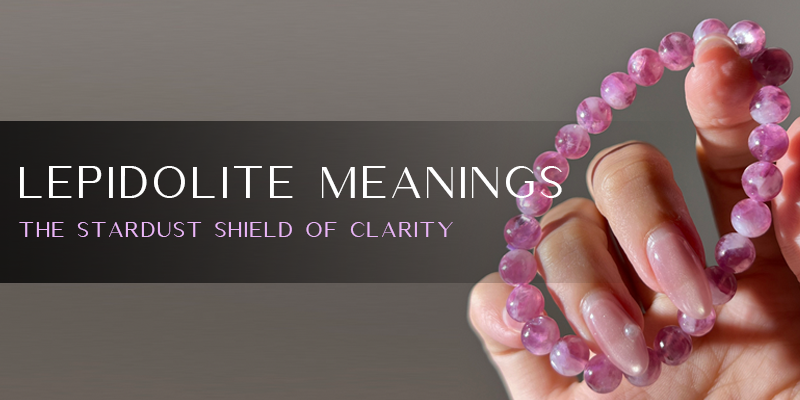
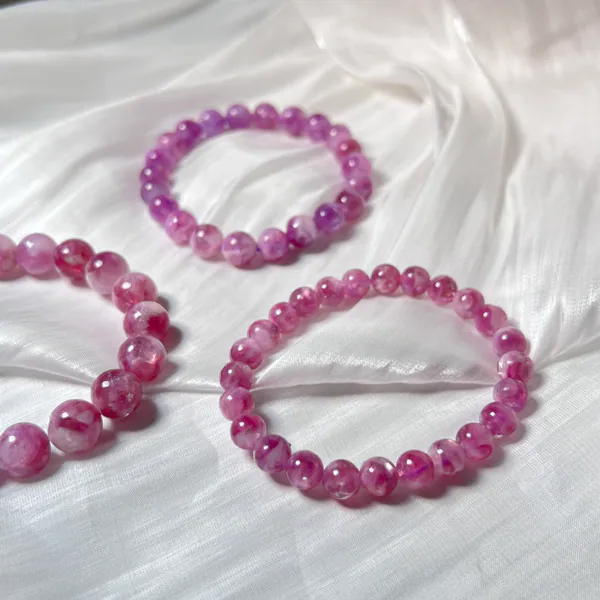
Lepidolite is a soft, lavender-to-rose mineral from the mica family, known in metaphysical circles as "The Peace Stone." Its name comes from the Greek words lepidos ("scale") and lithos ("stone") — a nod to the delicate, shimmering scales that make up its structure. First documented in 1792, it was originally called "lilalite" for its soft lilac color before receiving the name it carries today.
✧ Lepidolite Meanings & Benefits
In holistic and metaphysical traditions, Lepidolite is revered for its deeply comforting and nurturing frequency. Known as The Peace Stone, it serves as a gentle anchor for emotional well-being, mental clarity, and self-discovery—inviting you to reclaim your equilibrium through life's most transitional moments.
Here are five of Lepidolite's most valued metaphysical benefits:
1. A Companion for Transitions
Because of how it forms — as the final layer of a long geological process — Lepidolite is closely associated with life's in-between moments: the end of one chapter and the uncertain beginning of the next. It doesn't rush you through change. It sits with you in it.
2. Quieting an Overactive Mind
Lepidolite is often reached for when the mind feels crowded — too many open loops, too much analysis. Its association with lithium (long linked to mental stillness) is where this reputation comes from. Working with it is less about fixing a busy mind and more about giving it somewhere to land.
3. Strengthening Intuition and Self-Trust
Lepidolite resonates with the Third Eye and Heart Chakras, which is why it's traditionally used to deepen self-trust. It's less about gaining new insight and more about trusting the insight you already have — recognizing your own patterns without judgment.
4. Softening Self-Doubt in Creative Work
Because Lepidolite's energy is about settling rather than pushing, many creatives use it to quiet the inner critic that blocks expression — not to spark new ideas, but to clear away what's in the way of the ideas you already have.
5. A Gentle Energetic Boundary
Lepidolite is also used as a subtle shield — not an aggressive block, but a soft buffer between you and chaotic surroundings, helping you stay rooted at your own pace even in demanding environments.
✧ How to Wear & Use Lepidolite Jewelry?
There's no single "correct" way to work with Lepidolite — but a few traditional placements carry their own intent:
Left wrist — the "receiving" side. Worn here, Lepidolite is thought to invite its calming quality inward.
Right wrist — the "projecting" side. Worn here, it's more about carrying that calm outward into how you show up with others.
As a necklace, resting near the heart, it's used to encourage self-compassion and honest self-expression.
On a nightstand or desk, simply kept in view, it works less as jewelry and more as a quiet visual reminder to return to a centered state.
Some people build this into a small daily habit — holding the stone for a few slow breaths before a transition (a hard conversation, a big decision, the start or end of a day) rather than wearing it passively all the time.
✧ Metaphysical & Spiritual Meanings
Attribute
Lepidolite Energy Specifications
Primary Chakra
Heart Chakra (Anahata), Crown Chakra (Sahasrara)
Element
Fire
Numerology
8
Zodiac Signs
Libra, Pisces
✧ Lepidolite Mineralogy Properties
Property
Mineral Detail
Mineral Group
Mica Group (Lithium-rich Phyllosilicate)
Chemical Formula
K(Li,Al)₃(Si,Al)₄O₁₀(F,OH)₂
Mohs Hardness
2.5 – 3.0
Crystal System
Monoclinic
Luster & Cleavage
Pearly, layered shimmer with silky mica reflection
Discovery, Mining Locations & Rarity
History of Discovery: Lepidolite was first documented in 1792 by German chemist Martin Heinrich Klaproth. It was once referred to as “lilalite” due to its soft lilac coloration before receiving its current name, Lepidolite.
Global Mining Sources & Gem-Grade Rarity: While lithium is distributed globally, gem-grade Lepidolite suitable for luxury jewelry carving is exceptionally selective. The premier sources for high-luster, vibrant lilac-to-rose specimens include:
Brazil (Minas Gerais): Celebrated as the most prized sources for gem-grade Lepidolite, producing dense, rich magenta-violet specimens with vivid pearlescent sheets.
Madagascar & Zimbabwe: Renowned for producing high-clarity lavender-gray and rose-pink stones, often occurring alongside Pink Tourmaline.
United States (California & Maine) & Russia: Historic pegmatite fields yielding distinct lithium-mica crystals prized by mineral collectors and lapidaries worldwide.
Lapidary Yield Loss: Crafting spherical beads or polished cabochons from raw Lepidolite requires master-level lapidary skill. Due to its soft Mohs hardness (2.5–3.0) and delicate, layered cleavage, raw rough easily flakes or crumbles during precision cutting, resulting in significant material loss to yield flawless, durable gem beads.
Mineralogy & The Science of Lithium Mica
The unique geological conditions that forge this peaceful mineral over millions of years:
Pegmatitic Crystallization & Manganese Trace Elements: Lepidolite forms deep within late-stage granitic pegmatites—extreme geological environments enriched with rare elements. As silica-rich hydrothermal fluids cool slowly underground, high concentrations of natural Lithium integrate into the mica crystal structure, while trace amounts of Manganese impart its iconic lavender-pink pigmentation.
Phyllosilicate Architecture & Perfect Cleavage: Belonging to the phyllosilicate (sheet silicate) family, Lepidolite's atomic structure consists of two-dimensional sheets of silicate tetrahedra loosely held together by potassium and lithium ions. This yields perfect basal cleavage, allowing the mineral to naturally form microscopic, flexible layers.
The Magic of Pearlescent Sheen: When ambient light hits these microscopic, overlapping mica plates, it bounces off multiple internal layers simultaneously. This optical reflection creates Lepidolite’s signature pearlescent luster—a soft, silvery shimmer that glides gracefully across the stone's surface as it turns in your hand.
✧ How to Cleanse and Charge Lepidolite?
Method
Ritual Practice
Selenite Charging Plate
Rest your Lepidolite bracelet directly on a Selenite slab overnight.
Sacred Smoke Smudging
Pass the jewelry through the gentle smoke of Palo Santo, White Sage, or natural incense for 30 seconds.
Moonlight Bath
Place your crystal on a windowsill under full moonlight or soft nighttime skies.
Sound Bath
Ring a 432Hz crystal singing bowl or tuning fork near your jewelry.
ESSENTIAL CARE & PROTECTION WARNING:
1. Avoid Water Exposure: Lepidolite should not be soaked or submerged in water. With a soft Mohs hardness of 2.5 – 3.0, water can seep between its microscopic mica layers, causing the stone to flake, weaken, or lose its silky sheen over time.
2. Avoid Harsh Sunlight: Keep out of intense, prolonged sunlight, as direct UV rays can fade its delicate lavender and rose-pink hues.
✧ Frequently asked questions about Lepidolite
Q1: How to identify genuine Lepidolite?
Authentic Lepidolite is easily recognized by its distinct physical markers:
Stardust Mica Luster: As a mica mineral, genuine stones reflect light through microscopic, scale-like layers—creating a soft, pearlescent, silky shimmer.
Organic Color Depth: Ranging from pale lilac to rich rose-pink, authentic Lepidolite exhibits natural tone variations and never looks flat or uniformly purple.
Delicate Softness: Cool to the touch, it has a low Mohs hardness of 2.5 – 3.0—making it significantly softer than glass or quartz and easily scratched by metals.
Synthetic vs. Natural: Fakes (dyed quartz, glass, or plastic) lack internal mica sheets, displaying unnaturally flat colors, lightweight feel, or microscopic air bubbles under light.
Q2: What is the difference between Lepidolite & Amethyst?
While both mesmerize with ethereal purple hues, they belong to entirely different mineral worlds, visual aesthetics, and energetic signatures:
Mineral Family:
Lepidolite: A soft, lithium-rich mica formed in delicate, pearlescent sheets.
Amethyst: A solid crystalline quartz with a dense, glass-like structure.
Hardness & Durability:
Lepidolite (2.5 – 3.0 Mohs): Exceptionally soft and delicate—requires gentle handling and protection from water.
Amethyst (7.0 Mohs): Highly durable and scratch-resistant—ideal for everyday jewelry.
Visual Luster & Texture:
Lepidolite: Displays a silky, "stardust" mica shimmer that catches the light in soft, pearly flakes.
Amethyst: Features a vitreous, crystalline shine ranging from translucent glow to crystal-clear transparency.
Color Palette:
Lepidolite: Soft pastel tones—lavender-gray, pale lilac, and muted rose-pink.
Amethyst: Deep, saturated purples—vivid violet, royal purple, and rich wine-red.
Energetic Vibe:
Lepidolite (The Quiet Reset): Calms overthinking, soothes emotional burnout, and builds gentle energetic boundaries.
Amethyst (The High-Vibe Anchor): Elevates intuition, sharpens focus, and clears spiritual noise.
Q3: Who should not wear Lepidolite?
In modern crystal practices, no stone is "forbidden"—it is simply about matching the right energy to your current moment. However, because Lepidolite is deeply soothing, you may want to consider choosing another crystal:
During High-Hustle Days: When you need bold, fire-driven drive, its ultra-calming vibe can feel too relaxing. Pair or swap with Carnelian or Sunstone instead.
During Heavy Physical or Water Activities: As a soft mica mineral, slip it off during workouts or water routines to protect its pearly shimmer from scratches and moisture.