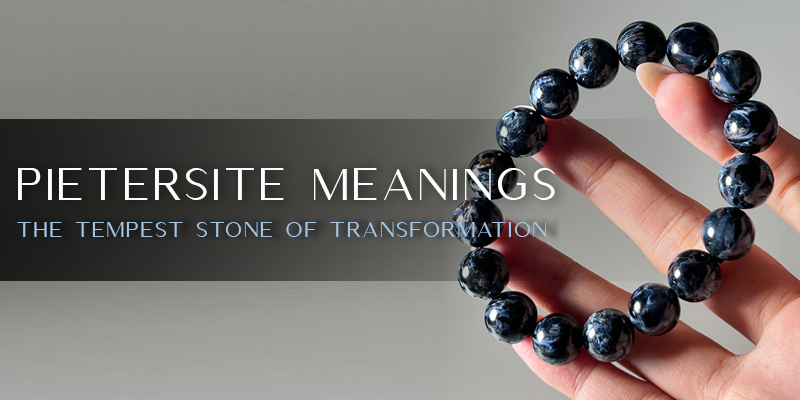
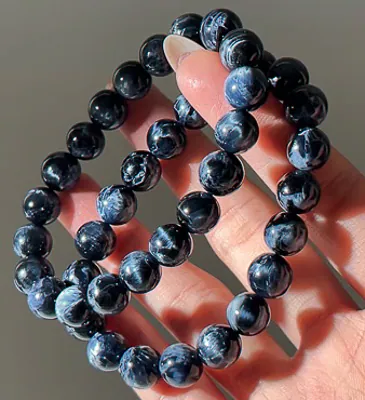
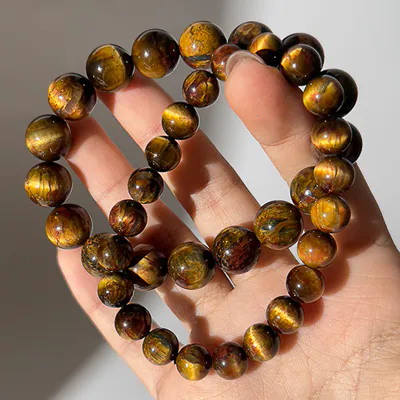
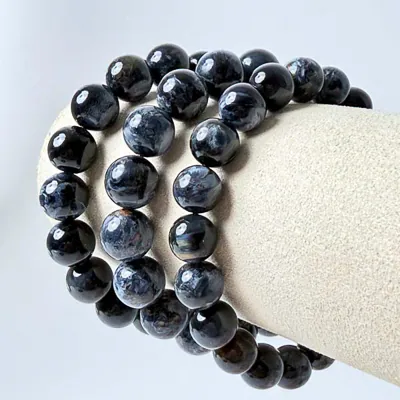
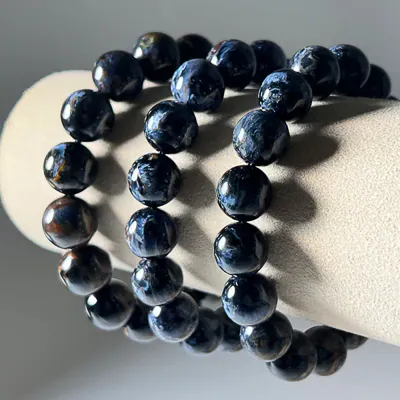
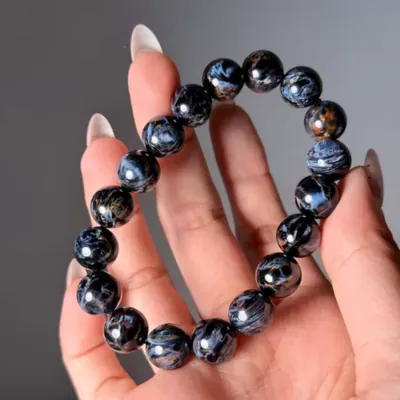
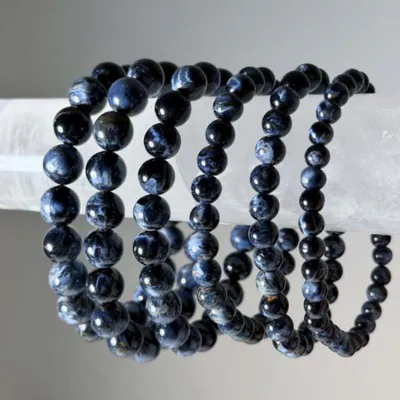
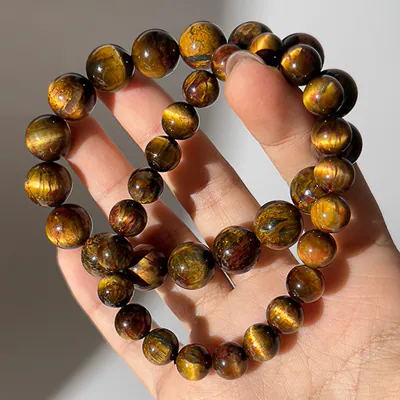
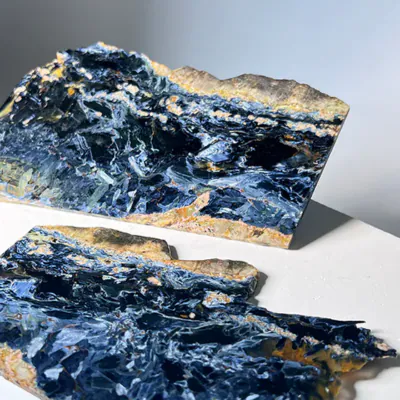
Pietersite, widely known as "The Tempest Stone," is an exceptionally rare variety within the Quartz family. Its most defining characteristic is its dramatic, swirling patterns featuring midnight blue, golden yellow, and reddish-brown bands. These colors interweave to create a striking chatoyancy, resembling lightning bolts illuminating a stormy sky.
✧Pietersite Key Meanings & Benefits
In crystal energy practices, representing the 'Storm Element,' Pietersite's dynamic energy is believed to act as a rapid catalyst for clearing stagnant vibes and facilitating personal transformation. Its energy is highly dynamic, acting as a rapid catalyst for clearing and transformation.
Here are the five core metaphysical benefits of Pietersite:
1. Unlocking Hidden Potential and Breakthrough
Associated with unlocking dormant potential and shattering self-imposed limitations. Pietersite is believed to help the wearer navigate difficult situations or sudden life changes, revealing brilliant and strategic turnarounds right in the heart of chaotic storms. It is often used by those seeking a major breakthrough in their personal or professional journey.
2. Cultivating Leadership and Mindful Confidence
Support an undeniable aura of authority and quiet confidence. It is frequently used to quiet inner hesitation and elevate one’s professional presence, making it an ideal companion for managers, executives, and anyone looking to lead, negotiate, and persuade with absolute assurance.
3. Sharpening Intuition and Strategic Vision
Pietersite is deeply connected with the Third Eye chakra, helping to pierce through illusions and see the absolute truth of any situation. By blending raw gut instinct with sharp logic, it supports high-vibrational, strategic thinking—making it highly favored for navigating high-stakes, and highly profitable decisions.
4. Drive, Focus, and Manifestation
Associated with the Solar Plexus, Pietersite serves as a powerful catalyst for relentless drive, willpower, and focus. In crystal work, it is used to crush procrastination and clear stagnant energy, making it much easier to bridge the gap between imagination and execution, effortlessly translating your grandest visions into real-world momentum.
5. Enhancing Alignment and Abundance Mindset
Pietersite is said to enhance your personal frequency and align energy with the wearer's highest career ambitions. By fostering a positive, prosperous mindset, it is frequently used to shift one's energetic signature, shifting one's energetic signature to align with professional opportunities, personal growth, and abundance.
✧Types and meanings of each Pietersite
The most distinctive feature of Pietersite is its deep blue hue coupled with a velvety texture. The primary differences among its varieties lie in the colors and visual patterns presented by the associated (symbiotic) minerals. Below are the most common Pietersite color categories:
Blue Pietersite Meaning:Brings clarity and enhances intuition, allowing you to see through illusions and make wise decisions.
Yellow/Gold Pietersite Meaning:Ignites personal power and confidence, giving you the courage to conquer doubts and attract wealth.
Multicolor Pietersite Meaning: Balances your vision with decisive action, keeping you steady to easily master major life changes and turn big plans into reality.
Blue Pietersite
Typically, when most people refer to Pietersite, they are talking about Blue Pietersite, which exhibits a deep, mysterious midnight-blue tone. High-quality Blue Pietersite displays a silky chatoyancy (cat's-eye effect) that is exceptionally delicate and mesmerizing.
Denim Pietersite
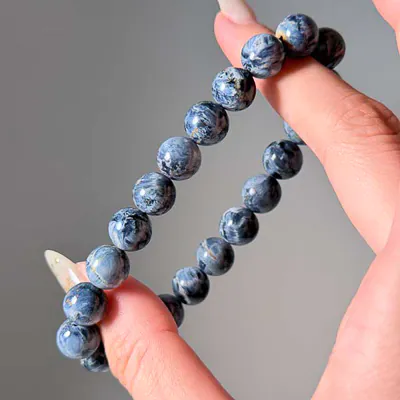
This variety features an interwoven grayish-blue coloration, with a hue resembling the casual, rugged look of washed denim. It delivers an understated yet highly individualistic and textured feel.
Multicolor Pietersite
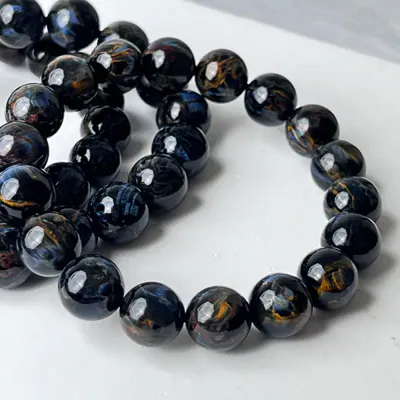
This type showcases a delicate fusion of blue, golden-yellow, and brown. Swirling dynamically like a Van Gogh oil painting, it creates a highly dramatic and visually striking effect.
Golden Pietersite
Golden Pietersite features pronounced mineral banding with a more solid, metallic luster. Because it lacks the unique depth and distinctive layering found in Blue Pietersite, the rarity and market value (unit price) of Blue Pietersite are generally higher in the collector's market compared to Golden Pietersite.
✧ A Gift from the Tempest | Awaken Your Inner Power
Pietersite is the key to unlocking your potential and a true symbol of personal vision and exceptional taste. Whether you are striving for a career breakthrough or looking to cultivate a grounded aura and a confident presence in your daily life, Pietersite serves as a profound, steadfast energetic shield right on your wrist.
SiO₂ (Quartz matrix) with inclusions of amphibole group minerals
Mohs Hardness
6.5 – 7.0
Crystal System
Trigonal (Quartz matrix)
Optical Phenomenon
Brecciated Chatoyancy (Cat's-eye effect with a dynamic, 3D moving light band)
Discovery, Mining Locations & Rarity
History of Discovery: Pietersite was first discovered in the field in 1962 by gem and mineral explorer Sid Pieters in Namibia. However, it wasn't until 1964 that the stone was officially introduced to the gem trade and registered in gemological literature under the trade name 'Pietersite' in his honor.
Extreme Rarity: Pietersite is one of the rarest gemstones in the world. To date, Namibia and China remain the only two historically significant sources of Pietersite globally, with current market supplies relying on existing rough reserves as active mining has largely ceased:
Namibia (Africa):The original and most premium source. Namibian Pietersite is renowned for its deep, highly sought-after blue bands (Blue Pietersite), sharp patterns, and intense silky luster.
Henan Province (China):Discovered during geological surveys in 1966, and later introduced to the international gemstone market in the 1990s. Chinese Pietersite typically features warmer tones, heavily leaning toward gold, brick red, and bronze due to a higher concentration of iron oxide.
Mineralogy & The Science of Chatoyancy
To understand why Pietersite possesses such a unique aesthetic, we must look at the science behind its formation:
Silica Encapsulation:Originally, Pietersite formed alongside fibrous Crocidolite (or Riebeckite). Over millions of years, Silica (primarily in the form of Chalcedony) encapsulated and embedded the Crocidolite fibers within its matrix, preserving their delicate, original fibrous structure.
Brecciated Structure:Unlike Tiger's Eye, which features parallel and orderly fibrous bands, Pietersite formed as a solution breccia. During its formation, circulating underground fluids chemically dissolved the soluble carbonate host rocks, creating cavities that subsequently collapsed and fragmented under gravity. Silica-rich fluids then cemented these fragments together, while late-stage hydrothermal activity grew the crocidolite fibers in chaotic, multi-directional patches within the voids. This intricate chemical and geological process is what gives the stone its signature unpredictable, swirling patterns.
The Magic of Chatoyancy:When light interacts with these chaotically overlapping microscopic fibers, it creates an optical phenomenon called Chatoyancy (cat's-eye effect). As you rotate the stone, bands of light glide smoothly across the surface, mirroring the dynamic flow of premium satin silk.
✧How to cleanse and charge Pietersite?
Method
The Ritual
Smoke Cleansing
Pass the stone through Sage or Palo Santo smoke.
Sound Bath
Use a singing bowl or or other resonant tone to reset its natural vibration
Crystal Allies
Place on a Selenite plate or Clear Quartz cluster overnight to purify and recharge its energy.
Moonlight Bath
Leave under the light of a Full Moon overnight.
In addition to the purification methods above, we recommend avoid harsh sunlight, chemicals, and saltwater
✧Frequently Asked Questions About Pietersite
Q1: How to identify genuine Pietersite?
Due to its popularity,replicas or synthetic lookalikes (made of resin, plastic, or treated glass) can sometimes be found on the market.Here is how to test for authenticity in seconds:
The Light Test (Chatoyancy):Real Pietersite has dynamic, 3D chatoyancy—silky light bands roll smoothly across the stone as you rotate it. Fakes have flat, static lines that do not move.
The Touch Test (Temp & Weight):Genuine stone feels distinctly cold and carries a satisfying heft. Plastic or resin fakes feel warm almost instantly and are noticeably lightweight.
The Pattern Test:Real Pietersite is beautifully chaotic; every single bead or cabochon is completely unique. If a bracelet has repeating, identical, or perfectly parallel lines on every bead, it is factory-made.
Q2: Is Pietersite toxic to wear or handle?
No, polished Pietersite is non-toxic and highly stable. The fibrous structure is completely and permanently encapsulated within the solid silica matrix, making it durable and suitable for wearing it as a bracelet and decor in your space.
Q3: What is the difference between Pietersite and Tiger's Eye?
Although both are chatoyant varieties of Quartz, Pietersite and Tiger's Eye are distinct in structure, formation, and market value:
Feature
Tiger's Eye
Pietersite
Pattern
Orderly, parallel bands of light.
Chaotic, shattered, and swirling storms.
Origin
Formed through the pseudomorphic replacement of parallel, orderly crocidolite (asbestos) fibers by silica.
Shares the same pseudomorphic origin as Tiger's Eye, but the host rock underwent intense tectonic fracturing and folding (brecciation) before or during the silica encapsulation, resulting in its chaotic, swirled patterns.
Rarity
Abundant and mined globally.
Extremely rare (only 2 known sources).
Value
Budget-friendly and widely accessible.
Highly collectible; commands a premium.
Q4: Why is Pietersite so rare and expensive?
The premium valuation and high collectibility of Pietersite are driven by three factors:
Geographic Depletion:Deposits are restricted exclusively to Namibia and China. The original African reserves are nearly exhausted and under stringent government export controls.
Lapidary Yield Loss:Due to its highly fractured, brecciated nature, raw rough is prone to splitting during cutting. Crafting flawless cabochons or spherical beads results in immense material loss, requiring master lapidaries.
Aesthetic Singularity:No two specimens are identical. The chaotic synergy of deep midnight-blue crocidolite and fiery golden-bronze goethite yields a unique, fluid masterpiece.